
August 16, 2026 - Coaching Business
[TEMPLATE] What to Include in Your Coaching Contracts & Agreements
What should a coaching contract include? Learn the essential clauses, how contracts vary by niche, and get a free template to protect your practice.

[TEMPLATE] What to Include in Your Coaching Contracts & Agreements
Many coaches put off creating a coaching contract because it can feel like just another piece of business admin.
But after working with coaches across different niches and countries over the years, one thing stands out: setting clear expectations and boundaries from the beginning can help prevent many of the messy client situations coaches would rather avoid.
Your contract is a foundation for how your coaching process runs, what clients can expect, and what happens when things don't go to plan.
Now, let’s take a look at what every coaching agreement needs, niche-specific differences to think about, special clauses worth adding, and a sample template you can adapt right away.
What Every Coaching Contract Needs
Scope of Services
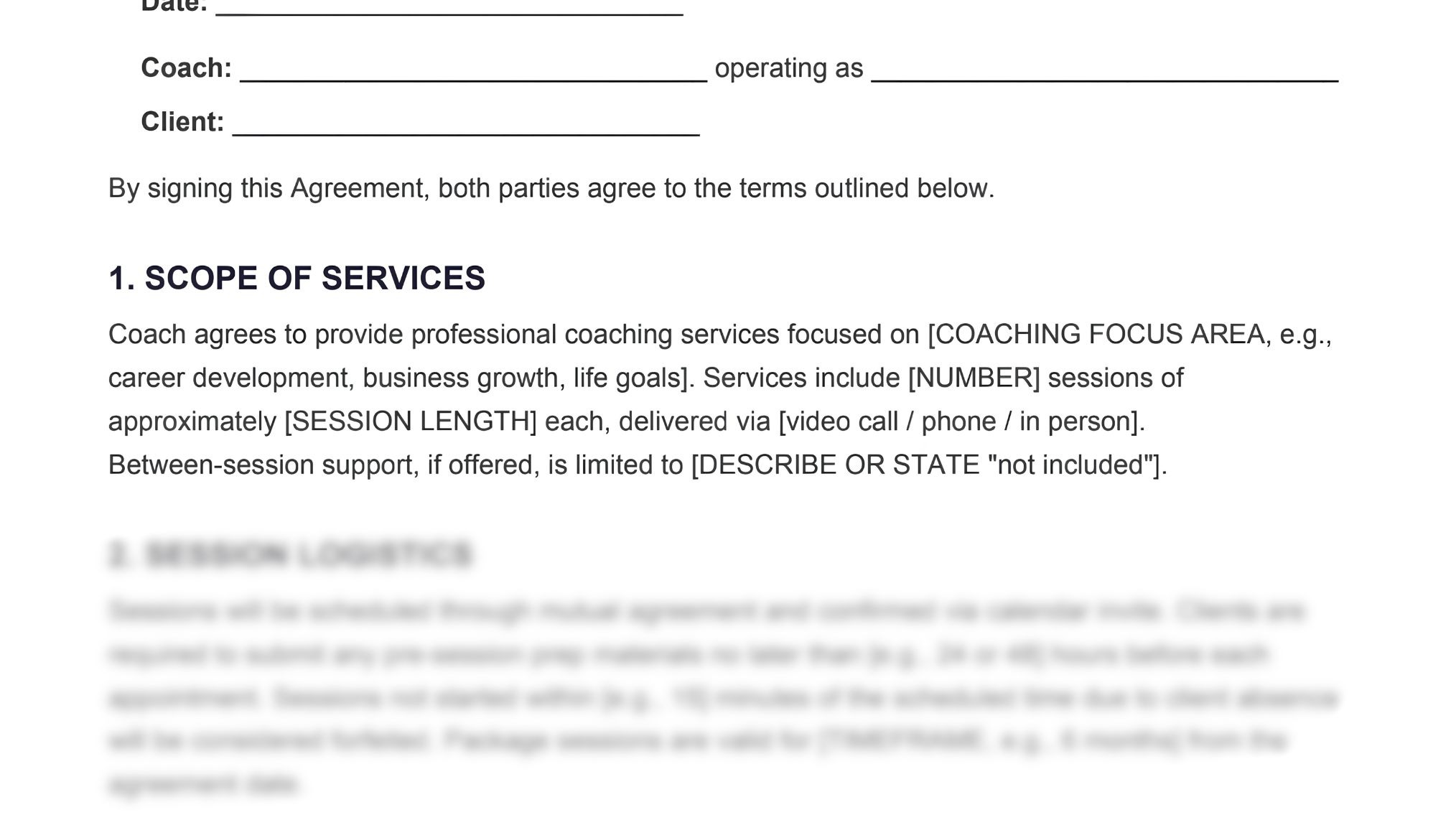
This section defines exactly what you're offering: the coaching format, frequency, duration, and delivery method. It's not enough to say "coaching sessions."
Spell out whether sessions are one-on-one or group, whether they happen by video, phone, or in person, and what's included between sessions, like email support or worksheets.
Vagueness in your contract can lead to mismatched expectations and potential legal troubles for your coaching business. If unlimited access to your advice via messaging is not something you want to offer, make that clear too.
Vagueness here is where misaligned expectations breed. If a client assumes unlimited messaging is part of the deal and you assumed it wasn't, you've got a problem that the clearest scope of services clause would have prevented.
Session Logistics
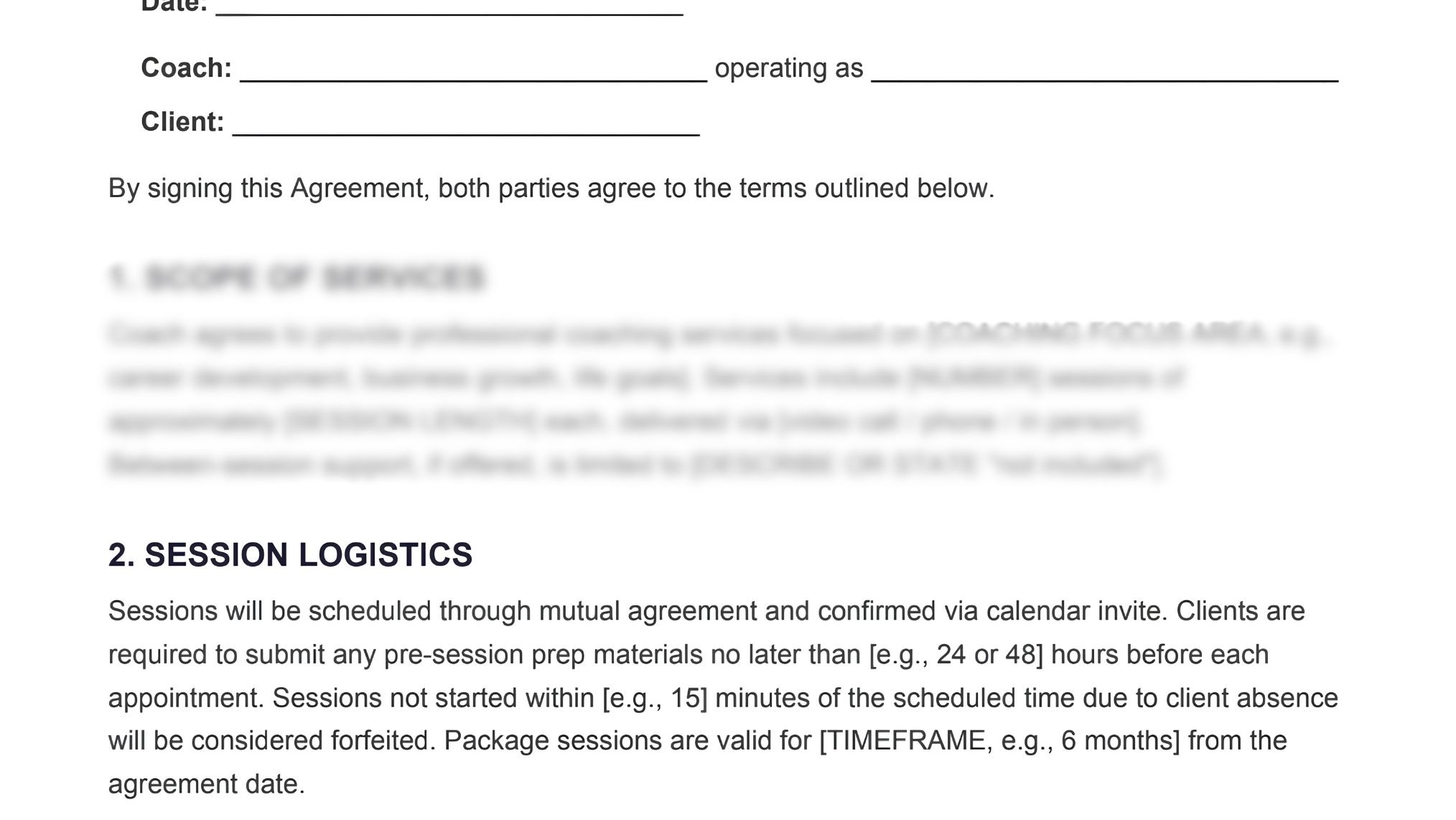
Note the total number of sessions, how long each one runs, and how clients book them. You should also address prep requirements.
The Wharton Executive Coaching Program, for example, requires clients to submit session prep forms at least 72 hours before each appointment because showing up unprepared wastes both parties' time.
Include session validity windows too. If you sell a 12-session package, clients need to know whether those sessions expire after six months or a year.
Fees and Payment Terms
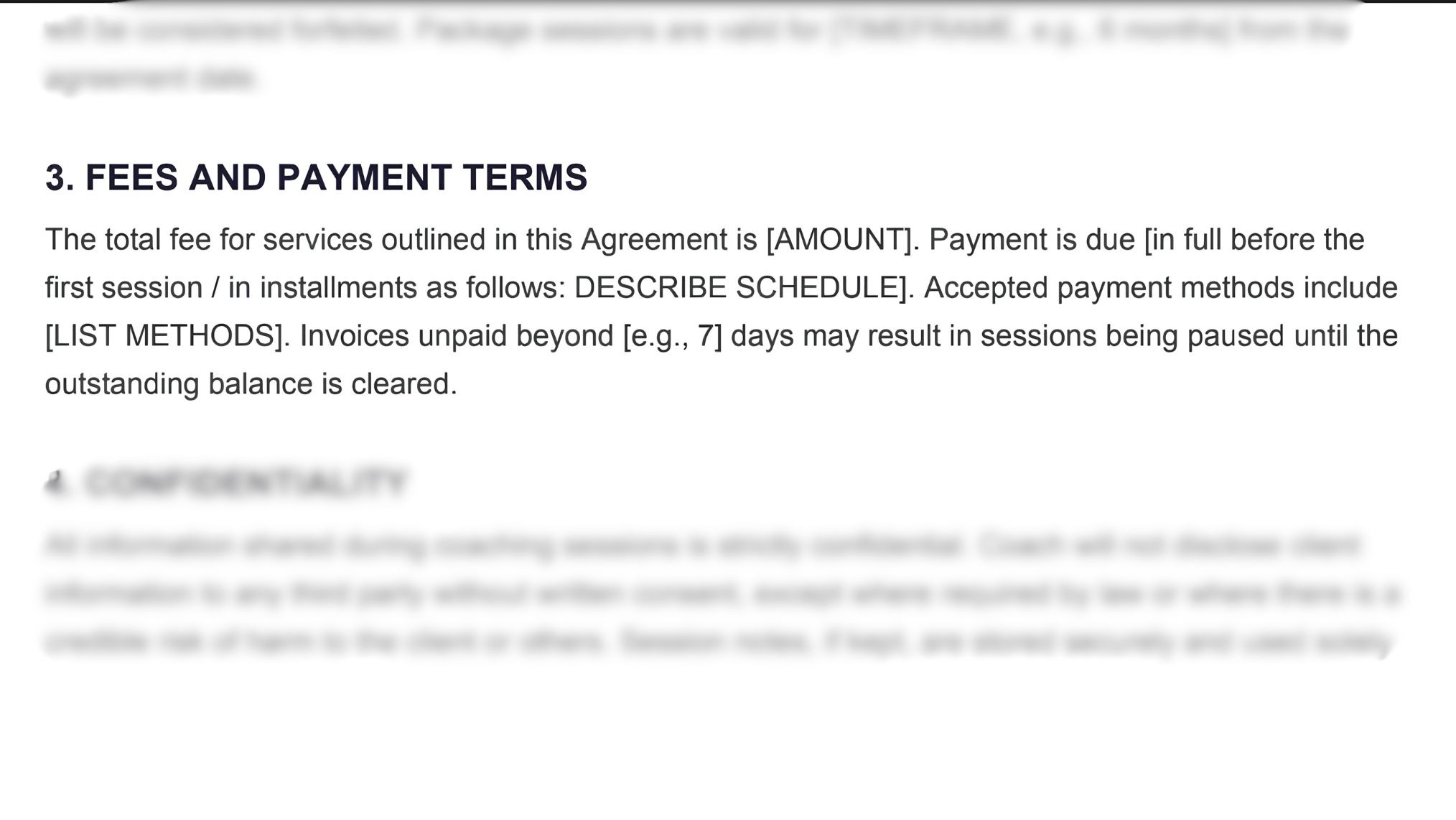
List your rate, the billing cycle, and which payment methods you accept. Then make it clear what happens with late payments.
A standard approach is to outline a grace period of five to seven days, after which sessions may be paused until any outstanding payments are cleared.
If you offer package deals or split-payment plans, those terms belong here as well. Being clear with your payment terms will help you avoid awkward conversations with client
Clarity upfront prevents the awkward conversation that happens when a payment quietly lapses.
Confidentiality
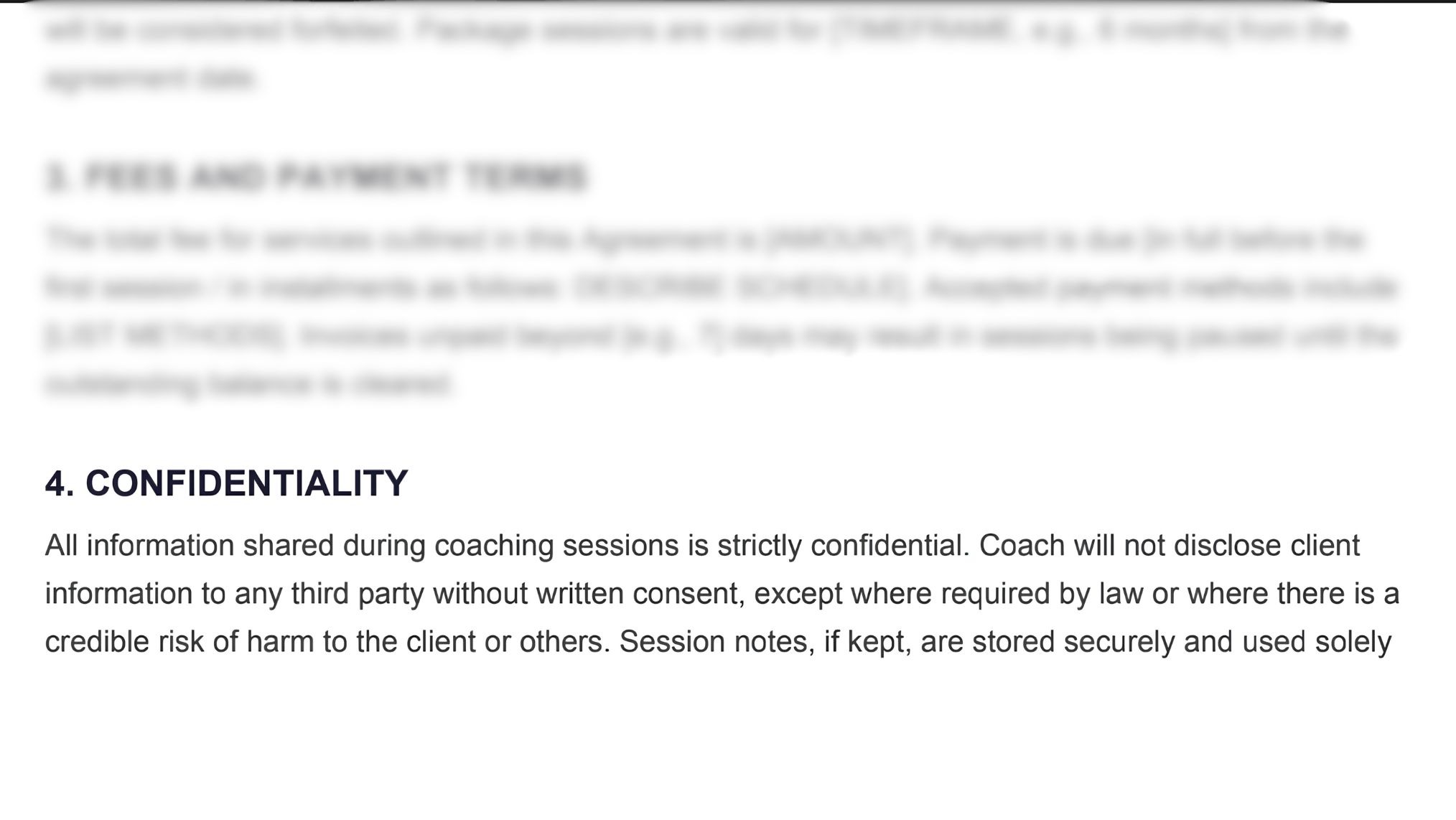
Clients share things in coaching they wouldn't share anywhere else. Your confidentiality clause needs to reflect that weight.
State clearly that session content stays private, that you won't discuss their information with third parties, and that any session notes you take are kept securely.
Confidentiality, however, is subject to certain exceptions. This includes situations involving a credible risk of harm to the client or others, or where disclosure is legally required. Your contract should make this clear to the client.
This mirrors the approach used across professional coaching programs, including Wharton's coaching framework.
Cancellation and Rescheduling Policy
Define your notice window. Most coaches use a 24 to 48-hour policy for cancellations. Be specific about what happens if a client misses a session with no notice, whether that session is forfeited or can be rescheduled once.
Wharton's executive coaching agreement limits rescheduling to two out of six sessions, with no-shows resulting in program suspension.
That's stricter than most private coaches need, but the principle is solid: clients respect what's documented.
Refund Policy
Decide whether you offer refunds for unused sessions, partial refunds within a set window, or a no-refund policy once coaching begins. Either approach is defensible, but whichever you choose, state it plainly so clients know before they sign.
Some coaches offer a 14-day satisfaction window for new clients. Others tie refunds to documented special circumstances only. The policy itself matters less than communicating it clearly in advance.
Limitation of Liability
This clause caps your financial exposure if a client claims the coaching caused them harm or loss.
It typically limits your liability to the fees paid during the contract period. Without it, a dissatisfied client could theoretically pursue damages far beyond what they paid you.
Keep it proportionate. The clause simply ensures the scope of any dispute stays reasonable.
Termination Clause
Either party should be able to exit the coaching relationship, and this clause explains how. Include notice requirements, what happens to unused sessions upon termination, and whether refunds apply.
A clean termination clause also protects you from being held to a contract indefinitely if a client stops engaging but never formally ends things.
Dispute Resolution
Rather than jumping straight to litigation, most coaching contracts specify a dispute resolution process such as mediation or arbitration first. This is faster, cheaper, and less adversarial for both sides.
Name the jurisdiction and governing law too, particularly if you coach clients in different states or countries. It removes ambiguity about where any dispute would be handled.
Intellectual Property
If you share proprietary frameworks, worksheets, or materials with clients, clarify upfront that these remain your intellectual property. Clients can use them for personal development, but they can't reproduce or resell them.
This matters especially for business coaches and executive coaches whose methodologies are a core part of their service value.
Special Clauses Worth Adding to Your Coaching Contract
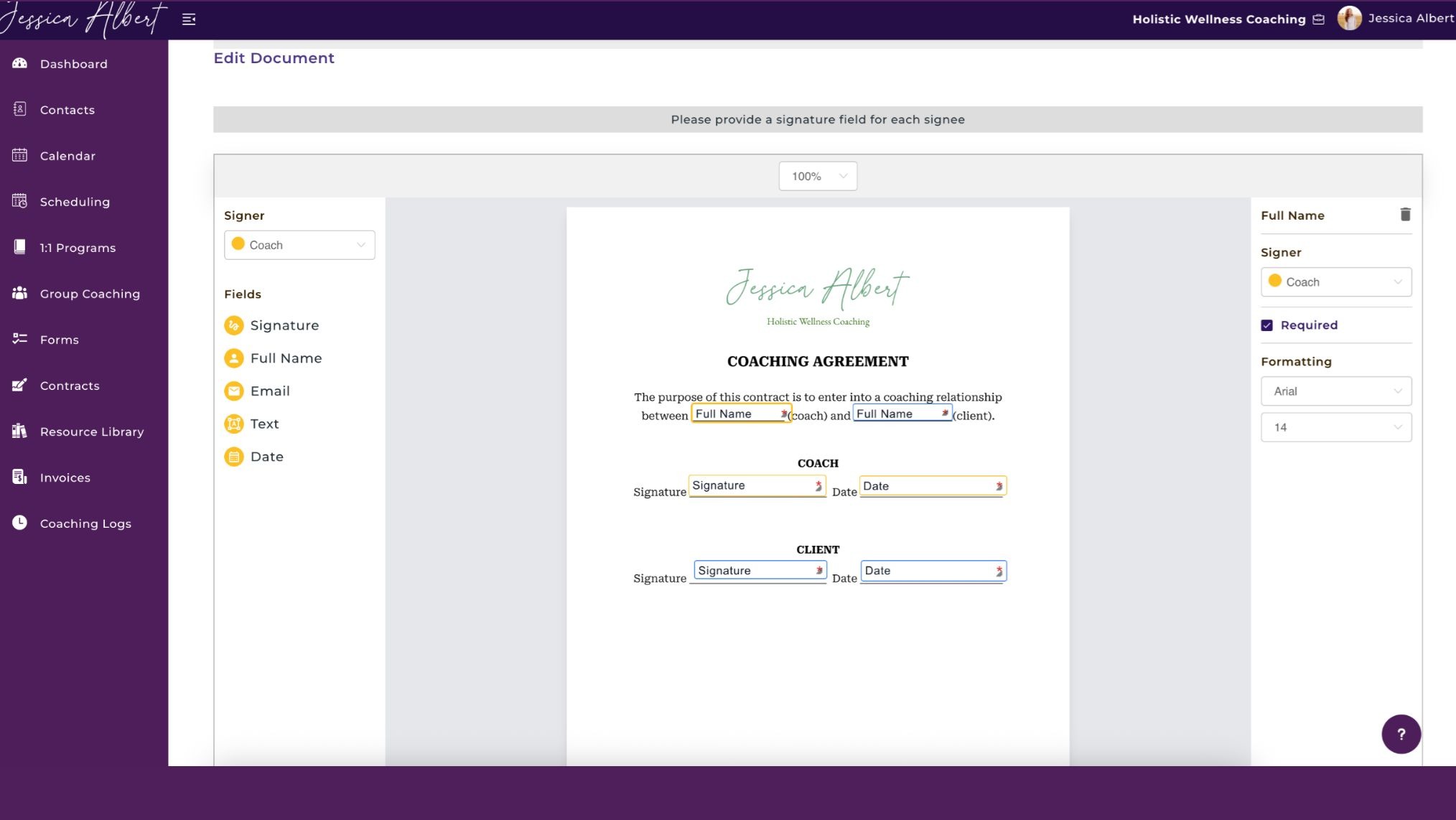
Alt text: CoachVantage’s contract management feature
Caption: CoachVantage’s contract management feature
ICF Credential Verification Disclosure
If you hold an ICF credential, your coaching agreement should reference it and note that your practice aligns with ICF's ethical guidelines.
This builds immediate credibility and sets a professional tone before a single session begins.
An ICF coaching agreement that acknowledges these standards also signals to clients that they're working with someone who takes the profession seriously and is accountable to an external code of conduct.
Release of Information
In some coaching arrangements, particularly within organizations or referral partnerships, third parties may need limited access to coaching outcomes.
A release of information clause defines exactly what can be shared, with whom, and under what circumstances.
Without it, you're navigating consent issues each time a sponsor or HR contact asks for an update, which happens more often than you'd expect in corporate and executive coaching.
Multi-Party Coaching Clause
When someone other than the client is paying for the coaching, whether that's an employer, a parent, or a program sponsor, you need to define each party's role and rights.
Who gets progress updates? What can the sponsor access? Where do your obligations to the client end and your reporting duties begin?
This clause prevents the uncomfortable situation where a sponsor expects a debrief, and the client assumes everything was private.
‘Coaching Is Not Therapy’ Disclaimer
This is non-negotiable. Your coaching agreement needs to state clearly that coaching is not therapy, counseling, or any form of mental health treatment.
The Wharton coaching agreement phrases it well: coaching is a distinct relationship, and clients needing therapeutic support should seek services from qualified counseling professionals.
This protects you legally and also sets honest expectations about what coaching can and can't do.
How Coaching Contracts Differ by Niche

Life Coaching Contract
A life coaching contract typically covers personal goal-setting, mindset work, and accountability structures.
Because the topics are deeply personal, the confidentiality and "coaching is not therapy" clauses carry extra weight here.
You'll also want to be specific about what support looks like between sessions, since life coaching clients often want ongoing access.
Manage Your Coaching Practice in One Place
CoachVantage automates your business workflows so you can focus on impactful coaching results.
A legal contract for a life coach doesn't need to be complex, but it does need to be clear about the personal nature of the work and the boundaries around it.
Group Coaching Contract
Group coaching contracts add a layer of complexity because multiple participants are involved.
Every member needs to sign, and the agreement should address group confidentiality: what's shared in the group stays in the group. Session recordings, if used, need explicit consent from all participants.
Refund and cancellation terms also work differently here. One person leaving mid-program doesn't entitle them to a refund for group sessions that already ran.
Business Coaching Agreement
Business coaching agreements tend to focus on deliverables, milestones, and business outcomes.
Intellectual property clauses matter more here, especially if you're sharing strategic frameworks or methodologies.
You may also be working with multiple stakeholders in the client's business, which warrants a multi-party clause.
Payment structures in business coaching also tend to involve retainers or milestone-based billing rather than simple per-session fees, so your payment terms need to reflect that.
Executive Coaching Agreement
Executive coaching engagements are often longer, more structured, and involve organizational sponsors.
The typical contract terms for executive coaching include six to twelve-month engagements, defined outcome metrics, and regular check-ins with HR or a program sponsor alongside the coaching itself.
Confidentiality clauses need to be especially precise because executives often share sensitive organizational information during sessions.
Sample Coaching Agreement Template
Use this template as a starting point and adapt it to fit your coaching niche and jurisdiction. Every clause is editable, so swap in your details and have it reviewed by an attorney before sending it to clients:
COACHING AGREEMENT
Professional Coaching Services Template
PARTIES TO THIS AGREEMENT
This Coaching Agreement ("Agreement") is entered into as of:
Date: _______________________________
Coach: _______________________________ operating as _______________________________ Client: _______________________________
By signing this Agreement, both parties agree to the terms outlined below.
1. SCOPE OF SERVICES
Coach agrees to provide professional coaching services focused on [COACHING FOCUS AREA, e.g., career development, business growth, life goals]. Services include [NUMBER] sessions of approximately [SESSION LENGTH] each, delivered via [video call / phone / in person]. Between-session support, if offered, is limited to [DESCRIBE OR STATE "not included"].
2. SESSION LOGISTICS
Sessions will be scheduled through mutual agreement and confirmed via calendar invite. Clients are required to submit any pre-session prep materials no later than [e.g., 24 or 48] hours before each appointment. Sessions not started within [e.g., 15] minutes of the scheduled time due to client absence will be considered forfeited. Package sessions are valid for [TIMEFRAME, e.g., 6 months] from the agreement date.
3. FEES AND PAYMENT TERMS
The total fee for services outlined in this Agreement is [AMOUNT]. Payment is due [in full before the first session / in installments as follows: DESCRIBE SCHEDULE]. Accepted payment methods include [LIST METHODS]. Invoices unpaid beyond [e.g., 7] days may result in sessions being paused until the outstanding balance is cleared.
4. CONFIDENTIALITY
All information shared during coaching sessions is strictly confidential. Coach will not disclose client information to any third party without written consent, except where required by law or where there is a credible risk of harm to the client or others. Session notes, if kept, are stored securely and used solely
to support the coaching engagement.
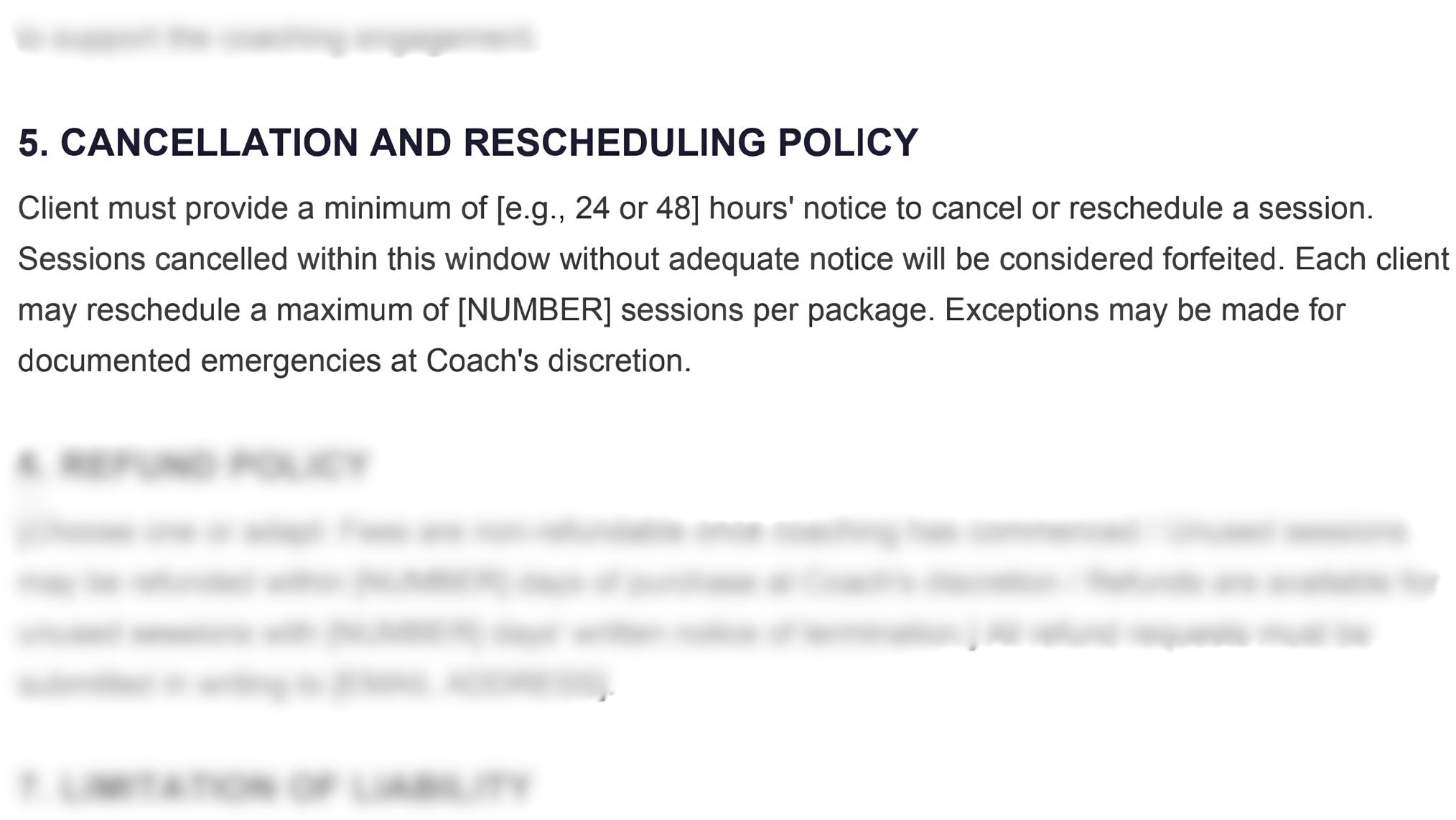
5. CANCELLATION AND RESCHEDULING POLICY
Client must provide a minimum of [e.g., 24 or 48] hours' notice to cancel or reschedule a session. Sessions cancelled within this window without adequate notice will be considered forfeited. Each client may reschedule a maximum of [NUMBER] sessions per package. Exceptions may be made for documented emergencies at the coach's discretion.
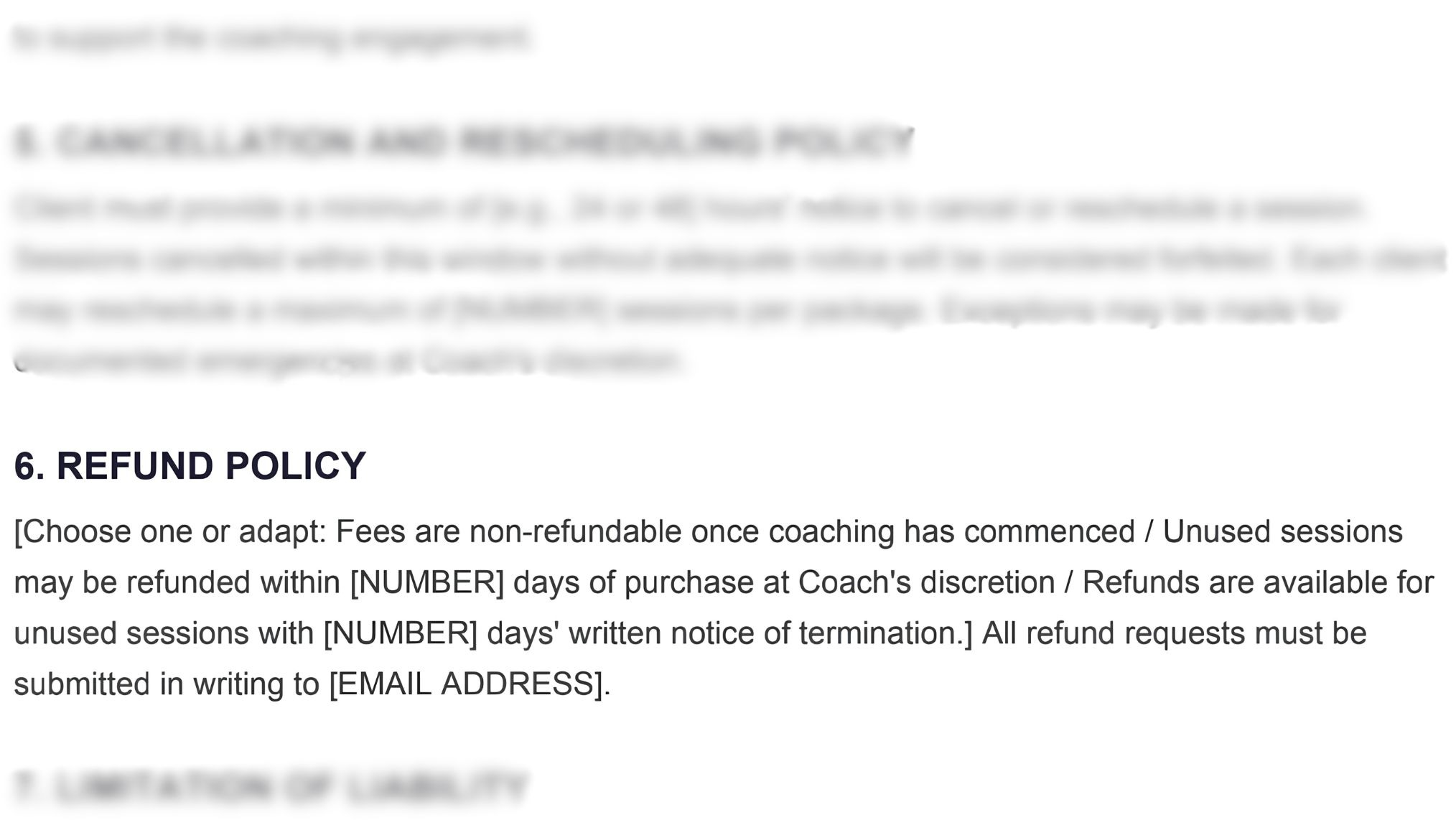
6. REFUND POLICY
[Choose one or adapt: Fees are non-refundable once coaching has commenced / Unused sessions may be refunded within [NUMBER] days of purchase at Coach's discretion / Refunds are available for unused sessions with [NUMBER] days' written notice of termination.] All refund requests must be submitted in writing to [EMAIL ADDRESS].
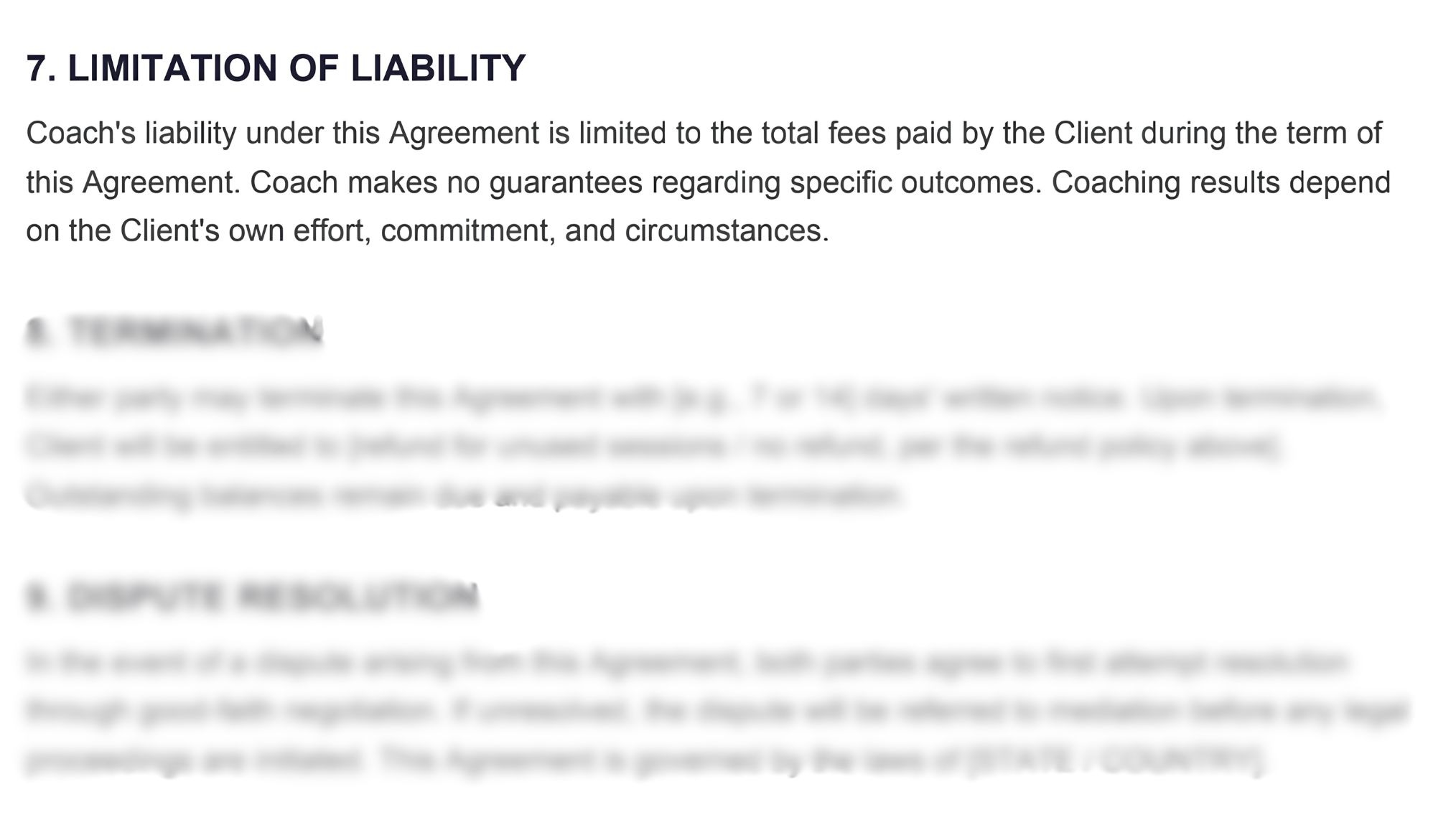
7. LIMITATION OF LIABILITY
Coach's liability under this Agreement is limited to the total fees paid by the Client during the term of this Agreement. Coach makes no guarantees regarding specific outcomes. Coaching results depend on the Client's own effort, commitment, and circumstances.
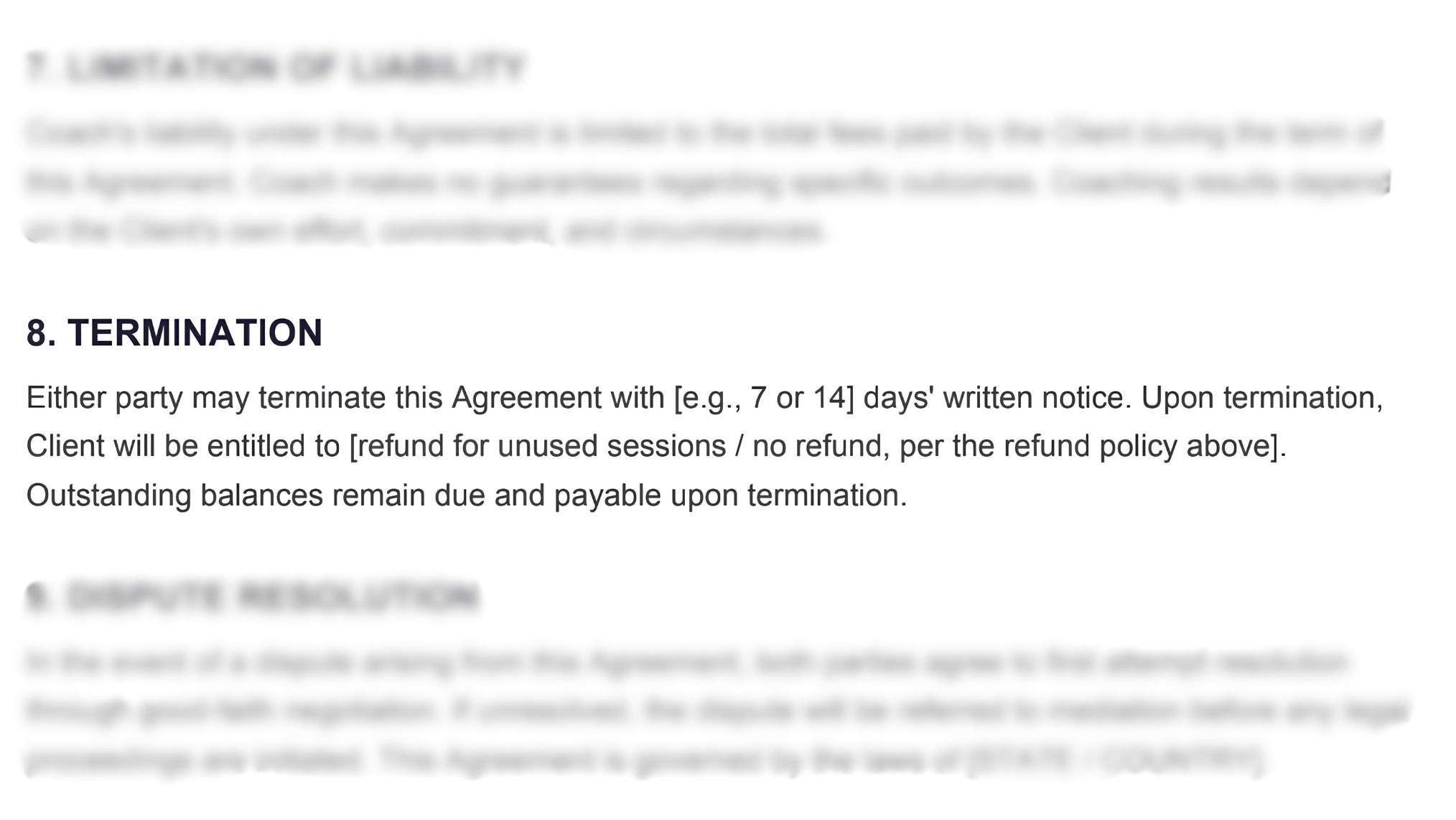
8. TERMINATION
Either party may terminate this Agreement with [e.g., 7 or 14] days' written notice. Upon termination, Client will be entitled to [refund for unused sessions / no refund, per the refund policy above]. Outstanding balances remain due and payable upon termination.
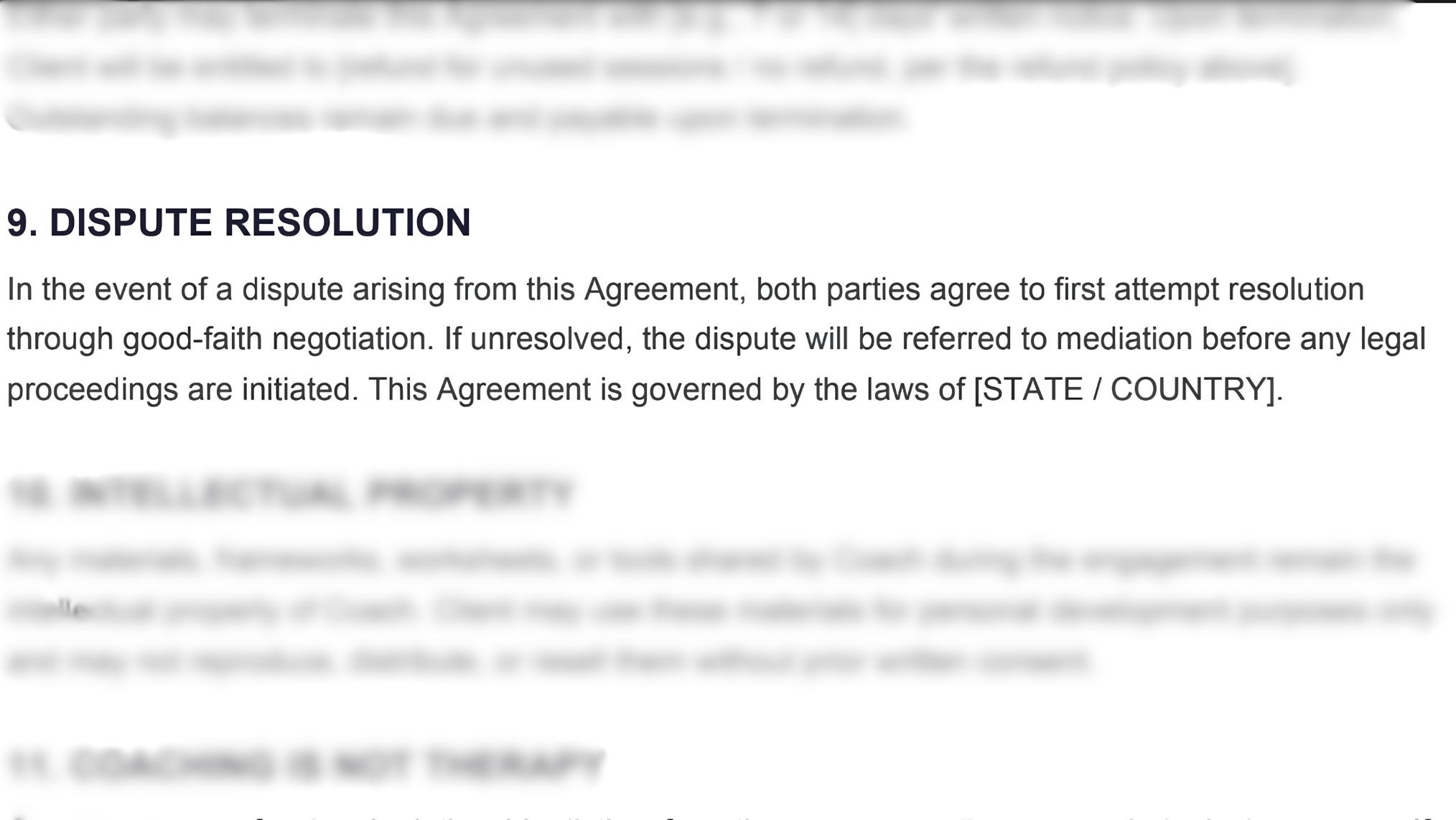
9. DISPUTE RESOLUTION
In the event of a dispute arising from this Agreement, both parties agree to first attempt resolution through good-faith negotiation. If unresolved, the dispute will be referred to mediation before any legal proceedings are initiated. This Agreement is governed by the laws of [STATE / COUNTRY].
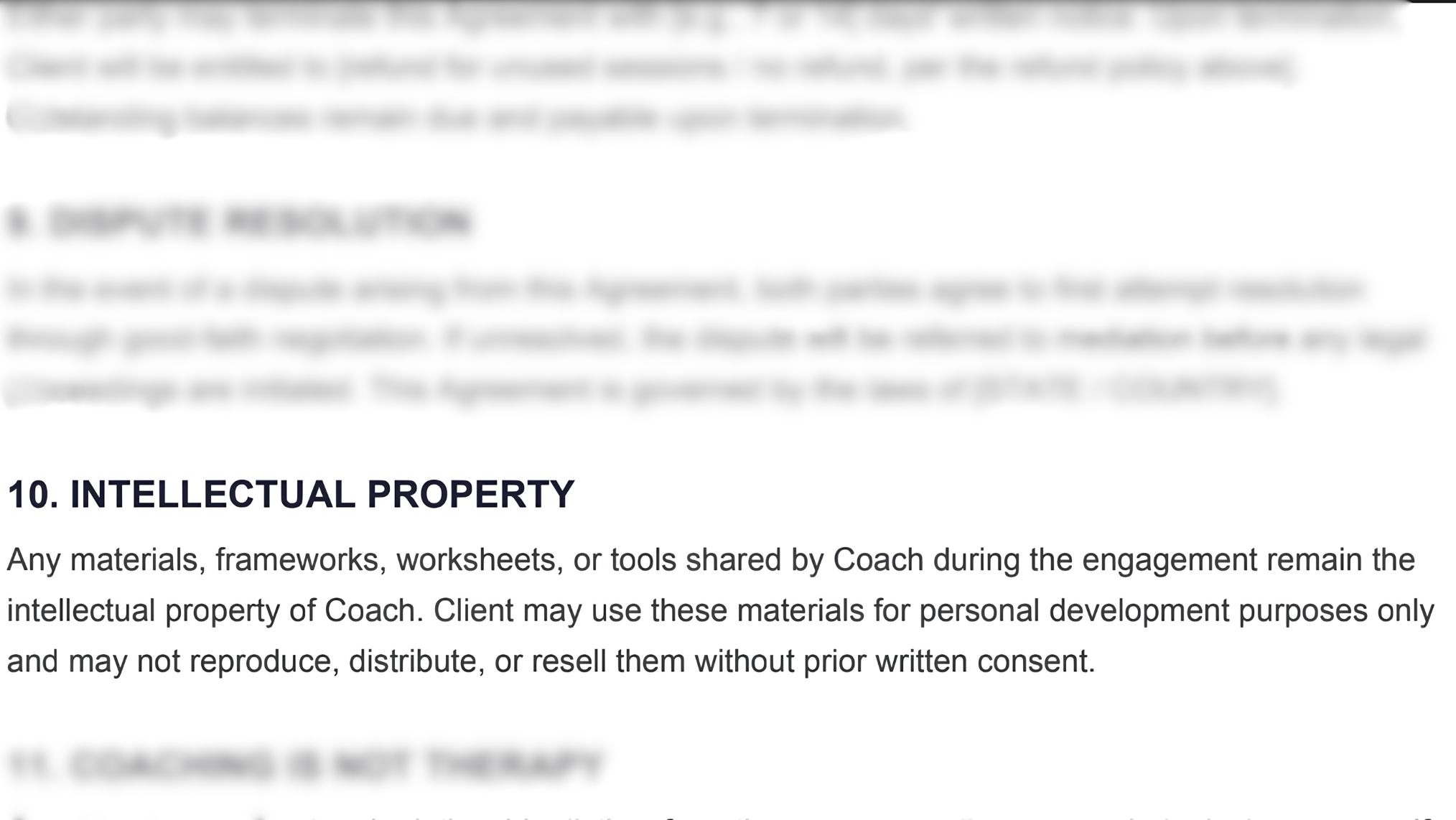
10. INTELLECTUAL PROPERTY
Any materials, frameworks, worksheets, or tools shared by Coach during the engagement remain the intellectual property of Coach. Client may use these materials for personal development purposes only and may not reproduce, distribute, or resell them without prior written consent.
11. COACHING IS NOT THERAPY
Coaching is a professional relationship distinct from therapy, counseling, or psychological treatment. If Client requires mental health support, they are encouraged to seek services from a licensed mental
health professional. Coach is not responsible for diagnosing or treating any psychological condition.
12. ICF ETHICAL GUIDELINES (IF APPLICABLE)
Coach holds [ICF credential, e.g., ACC / PCC / MCC] and adheres to the International Coaching Federation's Code of Ethics. Client acknowledges awareness of these standards as part of this Agreement.
13. ENTIRE AGREEMENT
This Agreement constitutes the entire understanding between Coach and Client and supersedes any prior discussions or representations. Any modifications must be made in writing and signed by both parties.
SIGNATURES
Coach: _______________________________________ Date: ___________________ Client: _______________________________________ Date: ___________________
This template is provided for informational purposes only and does not constitute legal advice. Coaches are encouraged to have their agreements reviewed by a qualified attorney in their jurisdiction.
Get Your Coaching Contract Signed Faster
A solid coaching agreement covers your scope, fees, cancellation terms, confidentiality, and the right disclaimers for your niche, and getting all of that signed before the first session shouldn't feel like a bottleneck.
CoachVantage makes it easy: you can build and send contracts, collect e-signatures, manage session scheduling, and handle payments all in one place, so you spend less time on admin and more time actually coaching.
Additionally, you can also upload your contract templates to CoachVantage and save them there. The template is ready for you to send to clients at any time, and you can also embed the e-contract into your program sign-up pages. This facilitates the client onboarding process since everything is performed in a single workflow.
There’s also flexibility for you to choose to send the e-contract to clients after they have signed up to your program. In this instance, CoachVantage will send an email automatically to your clients for them to e-sign.
The e-contract feature in CoachVantage enables a frictionless process of getting your coaching contract signed since it avoids the back-and-forth emails to complete the signature process.
If you haven't tried it yet, the FREE trial is a good place to start.
Frequently Asked Questions
What is a coaching contract?
A coaching contract is a formal agreement between a coach and client that outlines the terms of the coaching relationship, including services, fees, confidentiality, and cancellation policies. It protects both parties and sets clear expectations from day one.
Who needs a group coaching agreement?
Any coach running a program with two or more participants needs one. It covers group confidentiality, participation expectations, cancellation terms, and consent for recordings, all of which differ from one-on-one agreements.
What are the typical contract terms for executive coaching engagements?
Most executive coaching engagements run six to twelve months and include defined session frequency, outcome metrics, sponsor reporting protocols, and confidentiality terms that account for sensitive organizational information.
Do I need a separate life coaching contract for different niches?
You don't need a completely different contract, but certain clauses should be tailored to the niche. Life coaching contracts need stronger "coaching is not therapy" language, while business coaching agreements require more attention to intellectual property and deliverables.
Is an ICF coaching agreement legally binding?
Yes, as long as it meets the standard requirements of a valid contract in your jurisdiction: offer, acceptance, and consideration. The ICF credential reference adds professional credibility but doesn't change the legal enforceability of the agreement itself.
Want More Coaching Clients?

Get Your Free Guide to Create An Irresistible Lead Magnet
And attract clients who want to work with you.
Get Your Free Guide Now
Glen Oliveiro
Founder of CoachVantage
With a pulse on the coaching industry, Glen personally engaged with hundreds of coaches to develop a platform that addresses their day-to-day challenges. A visionary entrepreneur, Glen is committed to revolutionizing coaching practices through the innovative solutions offered by CoachVantage.
https://www.coachvantage.com



.png)