
January 17, 2026 - Coaching Business
What Accountability Coaching Really Looks Like In Practice
Accountability coaching is about helping clients take committed and consistent action to get results. This is how coaches do it effectively in practice.
What Accountability Coaching Really Looks Like in Practice
Accountability coaching plays a big part in almost every coaching relationship. It's no secret that the most successful coaches are those who have mastered the skill of helping clients take accountability to achieve their goals.
But how do they do it without being prescriptive, directive, or bossy?
You might have motivated clients with big goals and great insights, yet still notice client follow-through dropping off between sessions. Without clear accountability, intentions fade, actions get delayed, and coaching can be viewed as 'ineffective'.
Research has shown that when clients take accountability, it dramatically increases their likelihood of goal achievement. People are 65% more likely to complete a goal when they commit to someone else, and that rises to 95% when they have an accountability coach or buddy with regular check-ins.
This is where accountability coaching makes the difference—helping clients move from intention to consistent follow-through, even when motivation might dip.
What Is Accountability Coaching?
Accountability coaching is a structured coaching approach that helps clients follow through on commitments by creating clear goals, consistent check-ins, and supportive accountability systems. Rather than relying on motivation alone, accountability coaching strengthens ownership, self-trust, and consistent action toward meaningful outcomes.
Why Accountability Is Often the Missing Link in Coaching
Many coaches assume that if a client is motivated enough, accountability will naturally take care of itself. In reality, motivation isn't that reliable. Life events happen, conflicting priorities come up from time to time, and even self-driven clients sometimes struggle to maintain momentum without structure.
When accountability is weak, coaching relationships often show the same patterns:
- Clients show up for sessions with little progress since the last time you met
- Goals stay vague or keep getting shifted
- Sessions drift into small talk without hard action
- Both coach and client feel quietly frustrated and disappointed
Strong accountability coaching creates clarity and momentum at the same time. Clients feel supported rather than pressured. Coaches don't feel as though they are wielding a stick to drive action, and progress happens!
If you prefer to watch a YouTube video I created to explain all this, you can watch it here:
The 4 Essential Accountability Coaching Skills Clients Need
- Creating Clear Agreements – Establishing shared goals, expectations, and session focus.
- Active Listening – Listening beyond words to emotions, meaning, and resistance.
- Creating Awareness – Helping clients recognise patterns, blind spots, and assumptions.
- Accountability – Supporting consistent action without policing or being pushy.
These skills work together. Accountability isn't about policing your clients or making them feel guilty. It's about creating a structure that helps them align their actions with their desired outcomes. When it's executed well, accountability becomes the bridge between insight and change.
Or, as business coaching and strategy firm, Accountability Now, puts it: "We believe growth happens when strategy meets accountability". That's a powerful belief indeed because strategy counts for nothing without the committment and accountability to execute upon the strategy.
Reframing Accountability: Support, Not Surveillance
One of the most common misconceptions about accountability coaching is that it requires enforcing compliance. However, effective accountability is not about chasing clients or reminding them what they “should” have done.
It's about standing for the client’s intentions, even when motivation fades. It creates a safe space for clients to reflect honestly on what worked, what didn’t, and why.
Accountability is not about perfection. It is about learning how clients operate in real conditions—and designing commitments they can realistically sustain.
The Accountability Coaching Framework Used by Top Coaches
1. Make Commitments Explicit
Accountability begins the moment a client commits to action. Effective coaches help clients define commitments that are specific, observable, and chosen by the client—not assigned by the coach.
When commitments are written down and revisited consistently, they carry psychological weight and are far more likely to be completed.
One of the most effective ways to turn intentions into consistent action is thtough SMART goals. By helping clients define goals that are Specific, Measurable, Achievable, Relevant, and Time-bound, coaches create clarity and a tangible roadmap for progress.
Successful accountability coaches go a step further by building on this with the SMART Plus (SMART+) framework, which add other dimensions such as:
- Emotional resonance - help your client connect the goal to their core values.
- Create visual anchors - for example, ask your client to place a small sticker on their journal or notebook as a reminder of their committment to action.
- Celebrate micro-milestones - celebrate small wins with your clients as they accomplish baby steps towards the big goal.
The key is for the goal to become part of their identity, not just a task they need to complete.
Manage Your Coaching Practice in One Place
CoachVantage automates your business workflows so you can focus on impactful coaching results.
To help coaches use the SMART+ framework, I created the SMART+ worksheet that captures not just what the goal is, but why it matters, how they will remember it, and how they will acknowledge progress. You can download a free copy of the SMART+ worksheet here.
2. Have Regular Accountability Check-Ins
Consistency matters more than intensity. Regular check-ins—whether weekly, bi-weekly, or session-based—dramatically increase follow-through.
Structured systems help keep goals, session notes, and progress visible, so accountability becomes part and parcle of every coaching session rather than a 'by-the-way' topic.
3. Normalize The Missed Moments Without Judgment
Even with strong accountability structures, clients may miss commitments. What matters most is how those moments are handled.
Top accountability coaches explore breakdowns with curiosity, look for patterns rather than blame, and support clients in adjusting commitments realistically.
Pro Tip: Shifting Accountability to the Client
The most successful coaches don't take on the role of a 'boss'. Instead, they help clients co-create their own enviroments for success. Real-world feedback from experienced coaches suggests that rather than the coach chasing the client, the client should be the one who 'pushes' the accountability. For example, the client sends a photo to their coach of something that they've achieved that can be demonstrated visually, or simply sending a quick text confirmation of a completed task.
Encourage clients to create public, hard deadlines (like promising a report to a manager by 5:00 PM or announcing a public launch on social media) because the pressure of letting down their 'real world' network is ofter more motivating that letting down their coach.
A Simple 3-Step Accountability Coaching Script
You can integrate accountability seamlessly into your sessions using this three-step approach:
- Anchor the Commitment: “What specifically are you committing to before our next session?”
- Explore Obstacles and Support: “What might get in the way, and what support would help?”
- Set the Accountability Loop: “How would you like us to track progress and check in?”
This approach keeps ownership with the client while making accountability a shared agreement rather than an expectation.
Why Accountability Systems Matter in Coaching
Accountability often breaks down when information is scattered. When goals, session notes, and progress live in different places, valuable coaching time is spent digging through emails, files, and notes to remember points of discussion instead of building momentum.
Clear systems support accountability by keeping commitments visible, reinforcing continuity, and helping clients see progress over time.
Coaching tools like CoachVantage make it easy for coaches and clients to set goals for themselves and track progress. During each coaching or check-in session, goal progress (or lack of) can be easily visualized:
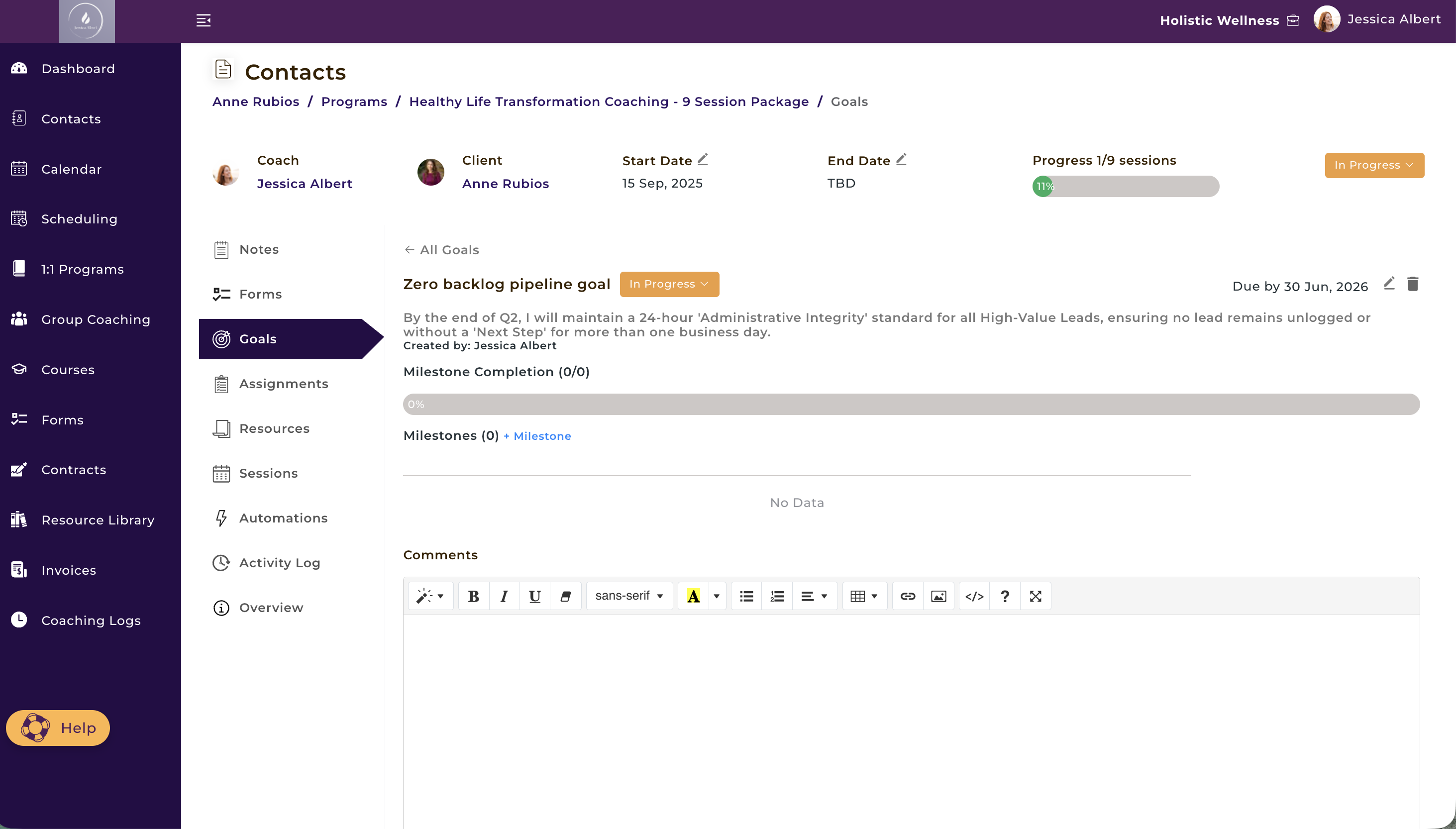
It's a great way to spark the coaching conversation about what were the key success factors that led to the goal being achieved, or conversely what was lacking that didn't.
CoachVantage keeps everything together in one place such as goals, notes, and check-in forms so that everything is professional and organized. It's why so many ADHD coaches love using CoachVantage, especially when helping ADHD clients who genuinely struggle with keeping committments.
Accountability Coaching FAQs
What is accountability coaching?
Accountability coaching helps clients follow through on goals by creating clear commitments, consistent check-ins, and supportive accountability structures that reinforce ownership and action.
Why is accountability important in coaching?
Accountability increases goal completion rates, builds momentum, and ensures coaching leads to measurable outcomes rather than insight alone.
How is accountability coaching different from managing or policing?
Accountability coaching focuses on support and awareness, not enforcement. Clients co-create commitments and accountability systems rather than having them imposed.
Can accountability coaching work when motivation is low?
Yes. Well-designed accountability structures support action even when motivation fluctuates, which is a normal part of long-term change.
Accountability Turns Coaching Into Action
To sum up, accountability coaching is not simply an add-on to effective coaching—it's the bridge between insight and outcome.
When accountability is clear, compassionate, and consistent, clients stop relying on motivational feel-good factors and start taking regular committed action. Progress becomes visible, sessions feel purposeful, and results happen.
As a coach, your role is to create the conditions where follow-through becomes natural, even when things get uncomfortable.
Your clients will thank you for it!
Want More Coaching Clients?

Get Your Free Guide to Create An Irresistible Lead Magnet
And attract clients who want to work with you.
Get Your Free Guide Now
Glen Oliveiro
Founder of CoachVantage
With a pulse on the coaching industry, Glen has personally engaged with hundreds of coaches to develop a platform that addresses their day-to-day challenges. A visionary entrepreneur, Glen is committed to revolutionizing coaching practices through the innovative solutions offered by CoachVantage.
https://www.coachvantage.com/about-us




.png)