
December 07, 2025 - Coaching Business
ICF Certifications And Coaching Credentials, Demystified!
Are you bewildered navigating the path to get your ICF Certification? What's the difference between a coaching certification and a coaching credential? This article unpacks it all for you and helps you get clear about whether you need to be certified.
ICF Certifications and Credentials - Is There a Difference?
Technically speaking, yes, there is a difference. It's actually a misnomer to call it an 'ICF Certification' because it's actually an 'ICF Credential'. As an organization, the ICF does not offer coaching certifications; instead it sets and defines a rigorous process to issue coaching credentials. It also audits and accredits education providers to ensure high quality and standards. More on that later.
Before we get into the details, let's first understand what the 'ICF' is and what it does. The International Coaching Federation, or ICF as it is more commonly known, is a non-profit professional organization whose mission is to advance coaching excellence, impact and value worldwide.
The ICF has several important functions and objectives to advance its mission, including setting standards for professional coaching, credentialing for coaches, accreditation of education providers and their programs, providing resources and advocating coaching's impact to transform societies and unlock human potential. The ICF has more than 57,000 coaches in its global member community.
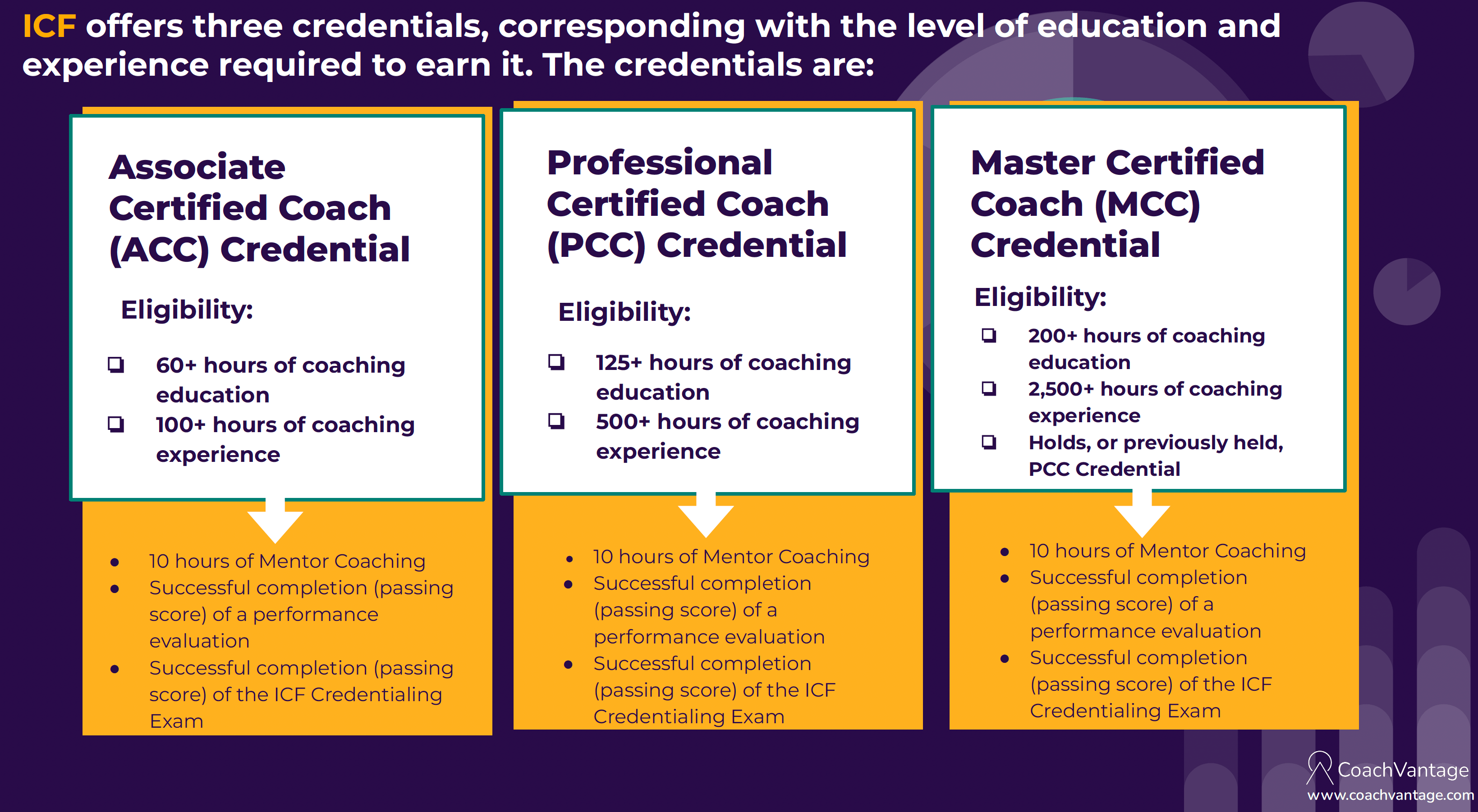
The ICF offers three credentials that coaches can aspire to attain. These ICF credentials are:
Associate Certified Coach (ACC)
Professional Certified Coach (PCC)
Master Certified Coach (MCC)
Now you might be asking, 'So, what's the difference between an ICF Credential and a coaching certification'?
Great question!
The terms "ICF Credential" and "ICF Certification" are often used interchangeably to refer to the ACC, PCC, or MCC credentials. Strictly speaking, though, these are credentials, not certifications.
There is a structured path towards attaining an ICF Credential. These are clearly defined by the ICF and can be found on the ICF website.
If you already have an ICF Credential under your belt, congratulations! It demonstrates the rigor and level of effort you have put in towards attaining this.
What Is a Coaching Certification?
Now that we've introduced the ICF and it's credentialing process, let's talk about coaching certifications. A 'coaching certification' can literally be issued by anyone or any coach training organization / institution. For example, a Coach who trains other coaches might tout that you'll get a 'Life Coach Certification' complete with a digital certificate and badge that you can use to proudly proclaim that you're certified after completing their program.
Do be wary of how easy it may seem to get certified by shady institutions or individuals who offer such programs! You might end up with a worthless piece of paper (or its digital equivalent) that isn't recognized by the ICF.
Remember that the coaching industry is unregulated. So, just as anyone can call themselves a 'Coach', it also means that anyone or any entity can also proclaim to offer training programs leading up to a 'coaching certification'.
I'm not saying that everyone who offers training programs leading to a coaching certification is bogus, but please do your research and due diligence to be sure that the certification is legit, the content is thorough and that you're not getting scammed!
As the de facto standard-setter in the coaching world, the ICF performs accreditation of education providers and the programs that they offer. The ICF performs audits to ensure quality and rigorous standards are adhered to. ICF states on its website that 'organizations that are accredited by ICF have completed a rigorous evaluation process to ensure their curriculum and policies meet the highest standards of the coaching profession'.
To make it easy for you to find an accredited education provider that meets your unique needs, the ICF provides a free Education Search Service (ESS). It's a searchable directory that you can use to enter your criteria like the program delivery method (virtual, in-person or a combination of both), training language, and even by coaching specialty. By using the ICF free ESS directory, you'll be assured that the education providers are legit and their programs are of good standing, leading to a coaching certifcation or coach training hours that's recognized by the ICF.
Top Questions That Coaches Ask About Coaching Certifications
If you're thinking about becoming a life coach or executive coach, you might be asking:
Do I need to have a coaching certification?
Do I need to be ICF credentialed?
How do I get trained and certified?
Are credentials necessary to be an effective coach or to attract clients?
These are all relevant questions! Before sharing my opinion, let me preface by qualifying that there is no one-size-fits-all answer. It really depends on your unique situation, your target clientele, your coaching approach, and your available budget.
If you prefer to watch a video I created to explain all this, you can watch it here:
Here are my thoughts:
Optional, But Valuable
Despite the coaching industry is unregulated, meaning anyone can call themselves a 'coach', having recognized credentials can make a world of difference. They help ensure you meet professional standards, engage in ethical practices, and build client trust. You’re not legally required to be certified, but it speaks volumes about your commitment to excellence. Clients and employers see that you’ve gone through rigorous training and adhere to ethical codes.
Manage Your Coaching Practice in One Place
CoachVantage automates your business workflows so you can focus on impactful coaching results.
Builds Your Credibility
ICF credentials and certifications can build credibility and help you stand out in a crowded marketplace. This is especially true if you are an executive coach or leadership coach and your ideal client profile is large corporations. Many organizations and corporations look for ICF credentials as a sign of quality and ethical practice. The responsible person such as the HR or reporting manager is on the hook for ensuring that they have done due diligence in seeking out the right coach with the right credential to coach their employees. And more often than not, this means that they need some form of proof in the form of a credential from a reputable body like the ICF. In this context, getting credentialed may indeed help you get coaching clients.
On the other hand, if you are a life coach with a focus on helping entrepreneurs get clarity and avoid burnout, these clients might not care too much about whether you are credentialed or not. They might be seeking out a coach who has 'been there, done that', i.e. they are seeking practical advice from a mentor.
While coaching in its 'strictest' form is more about helping clients find answers within themselves rather than giving advice, you can see how 'coaching' can mean different things to different people. Therefore, you need to assess your unique situation, ideal clients, and coaching approach to determine if getting certified will indeed be beneficial to you.
Certification vis-a-vis Credentialing
Many coaches I know have gone through intensive coach training at reputable coaching schools and attained a coaching certification at the end of the program. In addition, they also earned professional training hours which can be used to support the application for ICF credentialing. For some, the value that they feel that they have received from the training is more important than going through the ICF credentialing process. They are satisfied with the coaching skills and competencies that have learned and would rather not take the next step of getting credentialed.
Coaches who specialize in certain niches like health coaching, financial coaching, or sales coaching, for instance, may find more value from being certified by institutions that specialize in those respective niches. The Health Coach Institute (HCI), for example, offers a Health & Wellness Coaching Certification and a Life Coach Certification program. The training covers aspects of health, nutrition, and life coaching methodologies and it is also an ICF-accredited program. After going through the intensive training, coaches may continue down the path of getting an ICF credential since the program is accredited by the ICF. However, some coaches choose not to do so because their clientele are stay-at-home moms rather than corporate executives.
What Does It Take To Get An ICF Credential?
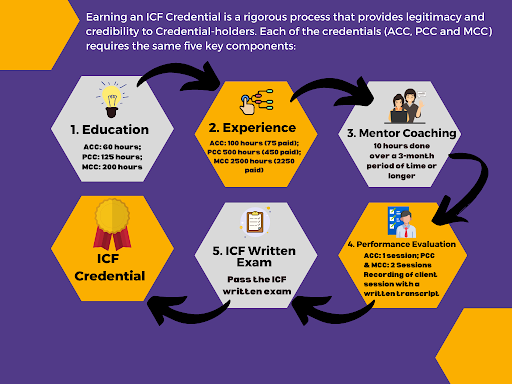
Earning an ICF credential is a rigorous process that provides legitimacy and credibility to credential-holders. Each of the ICF credentials - ACC, PCC, and MCC - require the same five components:
1. Education
Obtain coach-specific education aligned with the ICF definition of coaching, the ICF core competencies, and the ICF code of ethics.
2. Experience
Coaching experience hours must begin after you've started a coaching education program. Be sure to log your coaching hours systematically and faithfully after each of your client coaching sessions. Your coaching hours will need to be sent to ICF as supporting evidence during your application. Coaching platforms like CoachVantage help you log your coaching hours automatically after every coaching session, so you never forget.
3. Mentor Coaching
Receive mentor coaching to strengthen your skills within the ICF core competencies.
4. Performance Evaluation
Pass a performance evaluation(s) that assesses your coaching skills against ICF standards.
5. Exam
Pass a written exam designed to test your understanding of and ability to apply the ICF definition of coaching, ICF core competencies, and code of ethics.
Here's a visual of what the process looks like to get ICF credentialed:
Each credential, the ACC, PCC and MCC, has a specific set of eligibility requirements, namely the number of coach training hours completed and the number of hours of coaching experience under your belt.
Here's what this looks like:
Conclusion And Your Free Guide On Coaching Certifications and Credentials Here
In summary, you can be certified as a coach, but not necessarily ICF-credentialed, unless you decide to go down that path and apply for it. This is a personal choice and it really depends on your unique situation of whether earning an ICF credential would be beneficial to you and/or your clients.
Do note that an earned ICF credential is not evergreen. It needs to be renewed every three years and you will need to re-apply for your credential after fulfilling certain criteria like attaining 40 hours of Continuing Coach Education (CCE) credits which is essentially professional development training hours.
I hope this article has been helpful to understand that there isn't an 'ICF certification' per se. Rather, the more appropriate terminology to use is 'ICF credential' which refers to the ACC, PCC or MCC.
If you'd like to get all of this information in one handy place, I've created a comprehensive PDF guide that has all the essential information to help you better understand your options and the pathways towards getting certified and credentialed. It's completely free and you can get it here:
Get my free guide 'Coaching Certifications, Credentials and Competencies Demystified!' here.
At the end of the day, the significance of certifications and credentials is a personal choice. Your journey as a coach should prioritize delivering value, achieving client goals, and maintaining professionalism and ethics. These are the fundamental pillars that will support your personal development and business growth.
Want More Coaching Clients?

Get Your Free Guide to Create An Irresistible Lead Magnet
And attract clients who want to work with you.
Get Your Free Guide Now
Glen Oliveiro
Founder of CoachVantage
With a pulse on the coaching industry, Glen has personally engaged with hundreds of coaches to develop a platform that addresses their day-to-day challenges. A visionary entrepreneur, Glen is committed to revolutionizing coaching practices through the innovative solutions offered by CoachVantage.
https://www.coachvantage.com




.png)